An old algorithm got faster. Speed was never my problem.
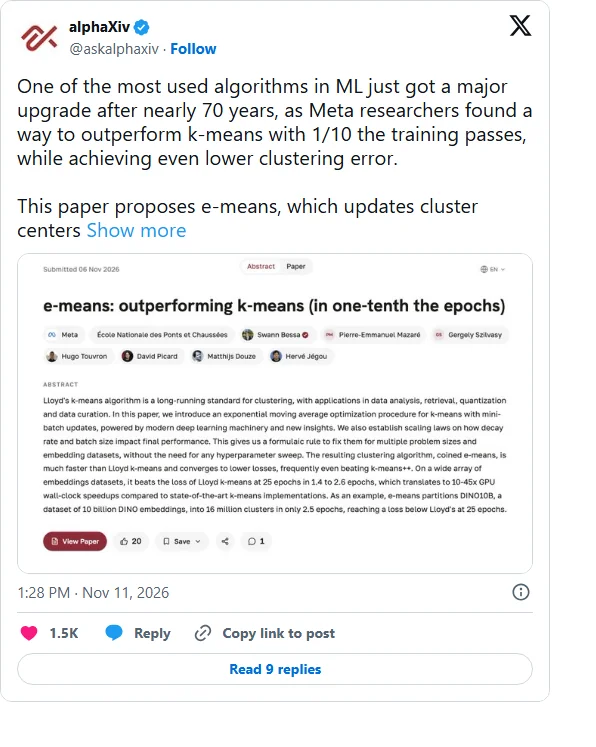
Researchers at Meta published e-means this month, a faster version of k-means, the standard method for sorting data into groups. Classic k-means rereads the whole dataset about 25 times. The new one gets a slightly better result in about 2 passes, which makes it 10 to 45 times faster on graphics chips. Their showcase sorts 10 billion images into 16 million groups.
alphaXiv, where I saw it, called it a major upgrade after nearly 70 years. That is true if you have 10 billion of anything. Faster small-batch versions have also been around since 2010, so this is a better-tuned method, not a new idea.
I used k-means years ago to turn social media data into personas. The computer was never the slow part. The slow part was me, deciding how many groups there should be and then reading each one to work out who was in it. The paper does not touch that part. Language models do: they can read a group of posts and say what the people in it have in common.
When a breakthrough makes the news, I now ask whether it speeds up the part of the job that was slow for me.